Poverty – the state of being extremely poor.
Despite being a developed country, those who are living at the lower end of the income distribution in the United Kingdom have a relatively low standard of living
As of 2017, 20% of UK people live in povertyincluding 8 million working-age adults, 4 million children and 1.9 million pensioners. Research by the JRF found nearly 400,000 more UK children and 300,000 more UK pensioners were in poverty in 2016-17 compared with 2012-13.
Poverty in the UK source ; https://fullfact.org/economy/poverty-uk-guide-facts-and-figures/
Being in poverty means different things to different people. That’s one of the reasons we have so many possible ways of measuring it in the UK.
The poverty figures you’ll often seen quoted are also usually ‘snapshots’ – they show how many people are in poverty at a given time. That’s only part of the story, because poverty is a temporary experience for some and a long-term situation for others. So it also helps to look at measures of persistent poverty which picks out people who’ve been in poverty for long periods.
DEFINING POVERTY
There are two broad things you need to decide when defining poverty: what you’re going to look at in people’s lives, and how you’re going to define the threshold between who’s in poverty and who isn’t.
Firstly, poverty is not quite the same thing as having low income. People and families can have different fixed costs to contend with as well, like childcare, housing and costs associated with disability, as well as different levels of savings or assets to draw upon.
Different measures of poverty capture different things—some are just about people’s incomes, others take housing costs into account, and some define material essentials people need for a decent standard of living, like warm clothing and basic holidays. Newer options also try to bring fixed costs and savings into the mix as well.
how you’re going to go about drawing a “poverty line”.
A new way of measuring poverty ;
One of the most comprehensive measures of poverty on offer at the moment is produced by the Social Metrics Commission (SMC). The SMC is an independent group of experts who have been working to improve the way we understand and measure poverty in the UK, which has been publishing estimates since 2018.
They found that in 2017/18:
- An estimated 14.3 million people are in poverty in the UK
- 8.3 million are working-age adults, 4.6 million are children, and 1.3 million are of pension age
- Around 22% of people are in poverty, and 34% of children are
- Just under half (49%) of those in poverty are in “persistent poverty” (people who would also have fallen below the poverty line in at least two of the last three years). This is as of 2016/17
- Working-age people in poverty are increasingly likely to be in working families
- Most poverty rates aren’t all that different to what they were at the start of the 2000s. The most marked reduction has been in pensioner poverty, it is almost half as common as it was back in 2000, while rates for working-age adults are now slightly higher
- Poverty rates fell in the years after 2010, as the UK recovered from the financial crisis, but are now showing clear signs of rising again
JRF.COM https://www.jrf.org.uk/our-work/what-is-poverty
Poverty affects millions of people in the UK. Poverty means not being able to heat your home, pay your rent, or buy the essentials for your children. It means waking up every day facing insecurity, uncertainty, and impossible decisions about money. It means facing marginalisation – and even discrimination – because of your financial circumstances. The constant stress it causes can lead to problems that deprive people of the chance to play a full part in society
here is no single best measure of poverty. It is a complex problem that needs a range of measures telling us different things.
JRF has launched a comprehensive strategy to Solve Poverty for all ages and places in the UK. We have set out a long-term and wide-ranging approach that looks beyond temporary political change, aiming for a major shift in attitudes, society and the economy.
Measures include:
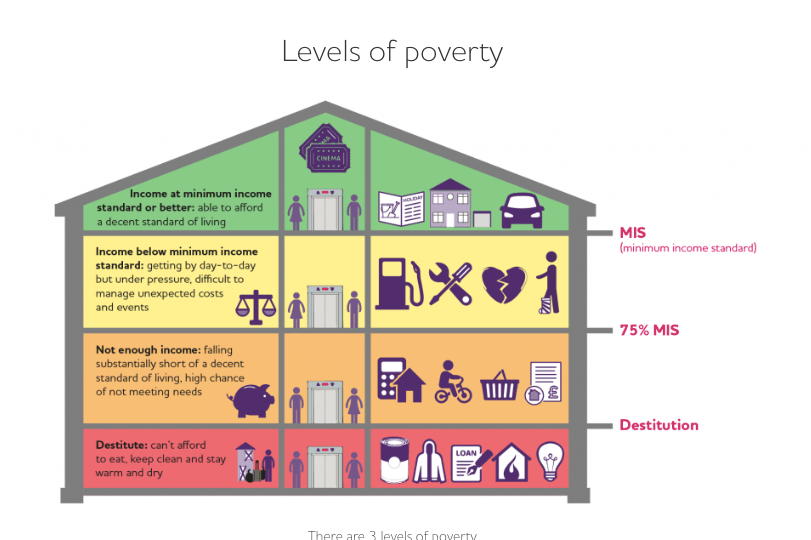
- JRF’s Minimum Income Standard (MIS) – MIS itself is not a measure of poverty, but is what the public has told us is sufficient income to afford a minimum acceptable standard of living
- relative income poverty, where households have less than 60% of contemporary median income
- absolute income poverty, where households have less than 60% of the median income in 2010/11, uprated by inflation
- material deprivation, where you can’t afford certain essential items and activities
- destitution, where you can’t afford basics such as shelter, heating and clothing.
Relative and absolute poverty can be presented before and after housing costs (these include rent or mortgage interest, buildings insurance and water rates) and are presented after direct taxes and National Insurance, including Council Tax.
What causes poverty in the UK?
The causes of poverty are things that reduce your resources or increase your needs and the costs of meeting them. Some of these causes can also be consequences, creating a cycle that traps you. Life events and moments of transition – getting sick, bereavement, redundancy or relationship breakdown – are common triggers for poverty.
Some of the causes of poverty in the UK today are:
- unemployment and low-paid jobs lacking prospects and security (or a lack of jobs): too many jobs do not provide decent pay, prospects or security. Many places have concentrations of these jobs or do not have enough jobs. Low pay and unemployment can also lead to inadequate savings or pensions
- low levels of skills or education: young people and adults without the necessary skills and qualifications can find it difficult to get a job, especially one with security, prospects and decent pay
- an ineffective benefit system: the level of welfare benefits for some people – either in work, seeking work or unable to work because of health or care issues – is not enough to avoid poverty, when combined with other resources and high costs. The benefit system is often confusing and hard to engage with, causing errors and delays. The system can also make it risky and difficult for some to move into jobs or increase their working hours. Low take-up of some benefits also increases poverty
- high costs: the high cost of housing and essential goods and services (e.g. credit, gas, electricity, water, Council Tax, telephone or broadband) creates poverty. Some groups face particularly high costs related to where they live, increased needs (for example, personal care for disabled people) or because they are paying a ‘poverty premium’ – where people in poverty pay more for the same goods and services
- discrimination: discrimination against people because of their class, gender, ethnicity, disability, age, sexuality, religion or parental status (or even poverty itself) can prevent people from escaping poverty through good qualifications or jobs, and can restrict access to services
- weak relationships: a child who does not receive warm and supportive parenting can be at higher risk of poverty in later life, because of the impact on their development, education and social and emotional skills. Family relationships breaking down can also lead to poverty
- abuse, trauma or chaotic lives: for small numbers of people, problematic or chaotic use of drugs and alcohol can deepen and prolong poverty. Neglect or abuse as a child or trauma in adult life can also cause poverty, as the impact on mental health can lead to unemployment, low earnings and links to homelessness and substance misuse. Being in prison and having a criminal record can also deepen poverty, by making it harder to get a job and weakening relationships.
Consequences of poverty in the UK
Some of the consequences of poverty are:
- health problems
- housing problems
- being a victim or perpetrator of crime
- drug or alcohol problems
- lower educational achievement
- poverty itself – poverty in childhood increases the risk of unemployment and low pay in adulthood, and lower savings in later life
- homelessness
- teenage parenthood
- relationship and family problems
- biological effects – poverty early in a child’s life can have a harmful effect on their brain development
How to solve poverty in the UK
Solving poverty is not quick or easy, but it is possible, starting with a vision, commitment and a plan.
We need a concerted effort by all – employers and businesses, private and social landlords, local and national policy-makers, the media, and all citizens and communities, including people in poverty themselves – if we want the UK to be free from poverty.
 ktwilliamsdesigns4BA