When we returned after christmas we were put into groups. I was with Sam, Tom and Jacob. When we got put in the groups we decided as a collective to understand exactly what sub topic we was going to achieve.
We created a mind map at first on large pieces of paper that allowed us to collect all our ideas together. Tom suggested immigration , I suggested medication prescriptions and sam suggested patent wait time and all this we added on the paper to conclude what we was going to do. On the large pieces of paper we added the different aspects that each of us was going into and develop research further.
My task was looking into medication prescriptions and I also looked more in patient wait time. as I think those linked and would be used well against each other. we all went off to research then we would come back together to develop ideas further.
My research development
Medication waiting time research
During the Christmas period, I research briefly into this topic as well as patient time. I wanted to develop it further and understand it deeply for the project that we was undertaking.
It has been said that ‘The NHS Constitution sets out that patients should wait no longer than 18 weeks from GP referral to treatment.’ which is not always the case due to the issues facing the NHS today.
The growing problem of treatment waiting time…
The NHS Constitution sets out that patients have a legal right to “start consultant-led non-emergency treatment within a maximum of 18 weeks of a GP referral”. The operational standard is that the time waited must be 18 weeks or less for at least 92% of patients who are waiting to start treatment (referred to as ‘incomplete pathways’). Performance against this target has worsened over the last couple of years, and the target was last met in February 2016.
In March 2018, only 87% of patients had a treatment waiting time of less than 18 weeks.
There is a reason that waiting times are longer and on this certain website they describe that. I decided to screenshot the diagrams they displayed to make it understanable towards my research.
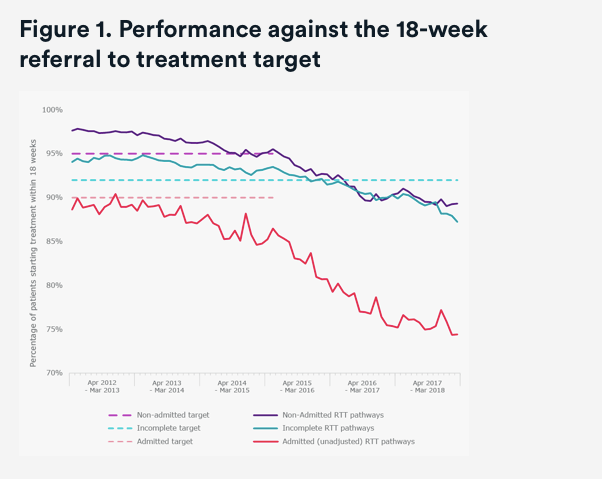

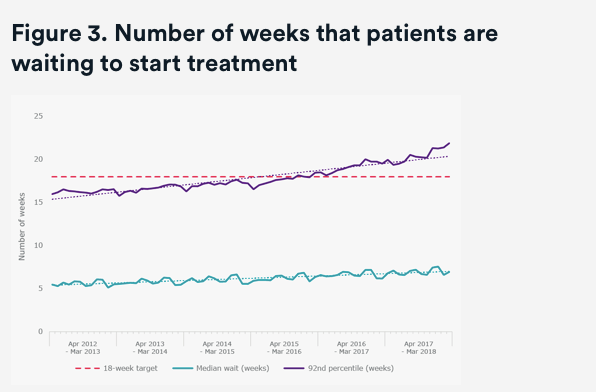
https://www.nuffieldtrust.org.uk/news-item/the-growing-problem-of-treatment-waiting-times
I do not shout this out to people as its a personal aspect that I do not feel the need to share but due to this topic I wanted to write about it in blog only so please do not share. I have been on anti depressants since I was 17 due to mental health issues. the process I have experienced is disgusting in comparison to other peoples issues. I am meant to have a 6 week consultation every single 6 weeks, I have currently not had one since September due to my doctors not having a spare appointments to see me. I am able to re order my tablets on an app, which I personally feel for anti depressants this should not be a thing. I struggle frequently with my mental health and would never share it with anyone as its my own issue but I personally feel like wait time and prescriptions should be a major priority when focusing on mental health issues.
Patient wait times:
I did look into patient times during the holidays however this was something I wanted to develop further as as a group we already sort of new this was the aspects we were looking into. I looked in personal about a and e waiting times and the overall wait time for the NHS service.
The waiting time target for patients in A&E is currently set to 4 hours from arrival to admission, transfer or discharge. However, not all hospitals have urgent care centres associated, which means people with minor injuries may have a longer wait until they are seen.
From https://www.health.org.uk/news-and-comment/blogs/nhs-performance-and-waiting-times
- Essential parts of the NHS in England are experiencing the worst performance against waiting times targets since the targets were set. This includes the highest proportion of people waiting more than four hours in A&E departments since 2004, and the highest proportion of people waiting over 18 weeks for non-urgent (but essential) hospital treatment since 2008.
- The target for treating cancer patients within 62 days of urgent GP referral has not been met for over 5 years, and survey evidence suggests more people are experiencing lengthening delays in getting GP appointments.
- Longer waits are a symptom of more people needing treatment than the NHS has the capacity to deliver. This reflects a decade of much lower than average funding growth for the NHS and workforce shortages, coupled with growing and changing population health needs. These pressures are exacerbated by cuts to social care and public health budgets, which make it harder to keep people healthy outside hospitals.
- It will take sustained investment in the NHS and social care to reverse lengthening waits. This will include filling existing staff vacancies and growing the workforce, investment in buildings and equipment, and stabilising the social care sector.
- If the NHS is to achieve its long-term vision of a service that can prevent ill-health, better manage long-term conditions, and treat people earlier, NHS staff will need time, space and skills to make change at all levels of the health and care system.
 ktwilliamsdesigns4BA