Companies helping poverty in the UK

APP - Research

I thought I would look into some companies that specialise in helping poverty in the UK so I could get an understanding of some existing cases out there – this would than develop ideas towards the design aspect through poverty countries. I personally think there is so much out there for child poverty, and teen poverty etc but there is hardly anything out there for family poverty and if you don’t experience this sort of poverty do people even understand it. I decided to look into a variety of companies that specialise in poverty within the UK that is not just child poverty, or teen poverty.

The one that stood out to me first and one where I actually took a lot of the statistic from through my research, we’re JRF. However, they do not seem to create a lot of advertising campaigns its mainly all online.

They claim they can solve poverty in the UK… Have they tho? thats a big statement to say if you cannot actually achieve that goal. Their website displays a variety of characters and then stories and statistics follow this.
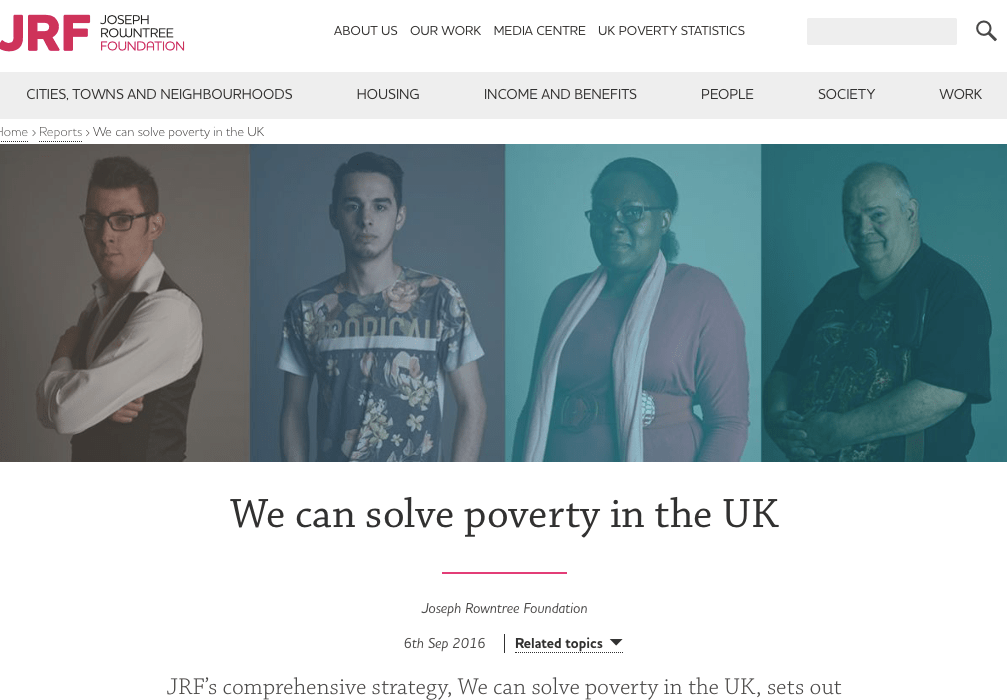
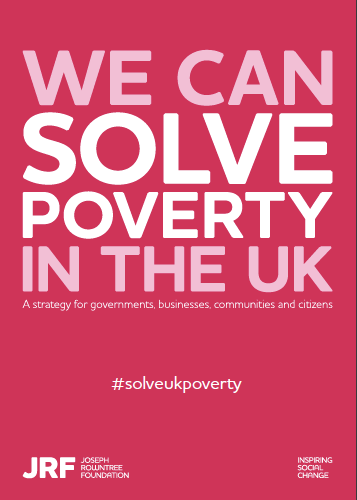
Within this website page, they have a PDF you can download which portrays way in which they want to solve poverty and this acts as their advertising campaigns. They display this PDF advert at the beginning and this then continues the theme throughout. WE CAN SOLVE POVERTY IN THE UK’ you automatically believe it you think ‘omg really how’ which makes you read on. the only thing for me is it looks like a poverty aid poster for periods and this is due to the colours they use. Why pink? They created a hashtag to then expand their audience and make it more aware to people.
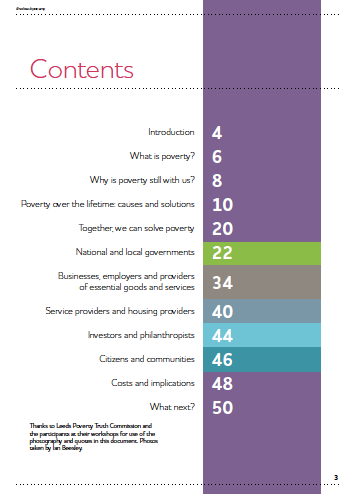
The pdf is almost like an editorial design, therefore I chose pages that symbolised the meaning well and fitted in with the editorial aspect of the design . They first display a contents page the displays a completely different colour theme in comparison to the front cover therefore does not really show a link…` It indicates all the issues and questions that face around poverty, ad probably all the questions that formed around the big statement they portrayed on the front cover. They display facts and statistics from goverments investor etc and make the information seem so reliable and understanding.
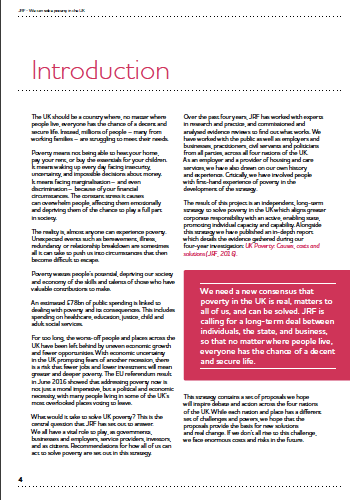
On the third page, there is still no sign of any photography and as a reader it makes you just want to skip past this page. This is introduction but if you look the amount of writing that has been displayed here it makes it hard for the reader to pin point a certain key information therefore makes them skip to another page. The only thing that stood out for me was int he pink box as its bold and in your face, and this statistics followed me through the rest of the design and I remembered it. But did not remember the rest. Displaying its key to make the most important information large and bold for the readers to understand and take it in. Having an introduction allows the reader to understand their purpose, and by the looks of it they are displaying the reasoning bending their mission and ways they want to stop poverty.
I chose this page because they do not just focus on a certain fact or statistic they display a lot. On the right hand side they display in a bright pink a topic opener, they then display facts on how they will achieve their five-point plan to solve poverty in the UK. To make this so believable and actually have faith in them they then display facts in a purple so it stands out about poverty, and the facts hit you hard and make you want to help out.

They continue through this 50 page magazine to express what poverty is, how to define it, what it’s like in the UK, and ways to help it. There are os many pages, therefore thought I would only analyse a few more that I thought would be beneficial for my magazine design and the over all purpose of designing for poverty and the sensitivity that goes around it.

This page when together is portrayed like editorial design, with the advertising image on the right and the information bout poverty on the left. I chose this one because to define poverty in their own words, again they portray a lot of information but this time they show case it with alternative colours to make it stand out. This is the first page where we see an image being displayed. With the quote on the image “it is so hard that you cannot [provide for yourself” This allows the page to become more personal and you understand this women has gone through it. She does not look like she’s homeless or the stereotypical ‘poverty’ which some places advertise she’s a normal women that has worked but struggle and thats what I think is important with designs like this to make sure you are sensitive towards the images you display.
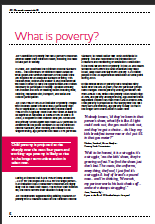
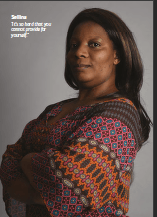
Overall this document makes you understand them, their values, and the ways to prevent poverty. This was an amazing inspiration for my designs, and allowed me to understand the sensitivity it that comes along with portraying a topic like this. Personal stories really sell it, and the personal quotes make you connect with the character. However I do think there should not be loads of type to inform people as there is a lot.
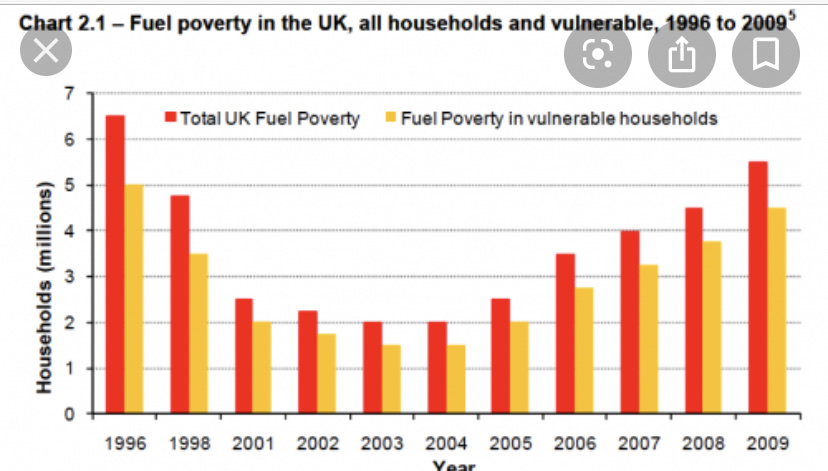
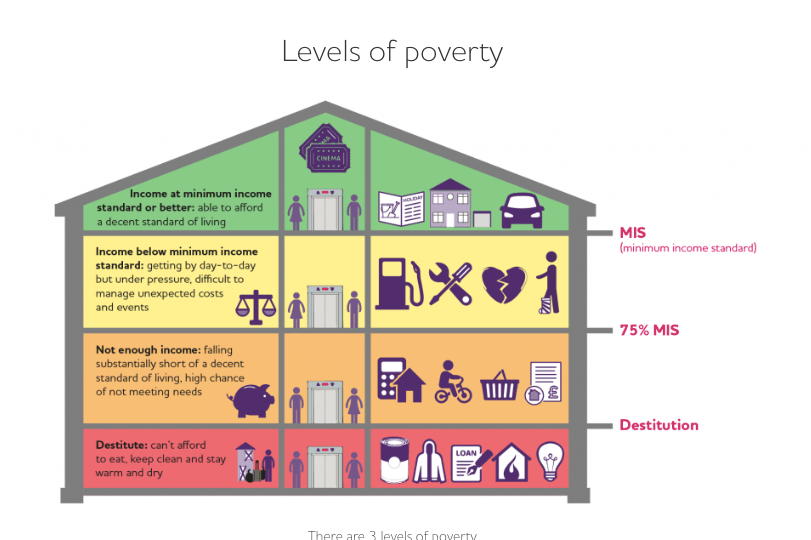
Poverty in the UK / PERSONAL STORIES

APP - Research, APP everything

Typed into google ‘poverty in the uk

Despite being a developed country, those who are living at the lower end of the income distribution in the United Kingdom have a relatively low standard of living.

Poverty affects millions of people in the UK. Poverty means not being able to heat your home, pay your rent, or buy the essentials for your children. It means waking up every day facing insecurity, uncertainty, and impossible decisions about money.

Key words

  • Not being able to heat your home
  • Pay your rent
  • Buy the essentials for your chikdren
  • Facing insecurity
  • Uncertainty
  • Impossible decisions about money

What causes poverty in the Uk?

  • Wage inequality. … 
  • Job insecurity and part-time work. … 
  • Unemployment. … 
  • Economic inactivity Related to unemployment is economic inactivity. … 
  • Old age People over 65 have traditionally been more at risk of relative poverty, as pension incomes are significantly less than average incomes.

Knowing the poverty in. the UK and how it has increased over the years, I decided to look into a few case studies that indicate house hold poverty. The most ‘typical’ idea of being in poverty comes in 5 forms… (information taken from https://www.poverty.ac.uk/living-poverty/personal-experiences)

  • single parents on benefits
  • the young unemployed
  • low-paid workers supporting a family
  • adults who are disabled
  • single pensioners.

Single parent poverty:

Being a single parent is hard enough, then being on the poverty line makes it 10 x harder. The first case study I looked into was a single parent named Jenny 39. Here is her story.

Jennie is 39 and unemployed. She lives with her three sons, all of whom have disabilities, in Redbridge, outer London. The family has lived in temporary accommodation for the last 12 years.

Jennie worked as a hairdresser when she left school and then switched to part-time work when she started a family. Her middle son, Mark, 13, contracted meningitis when a baby and Jennie left work to care for him. He is visually impaired and has Perthe’s disease, as a result of which he cannot walk long distances. Jordan, 16, has attention deficit hyperactivity disorder (ADHD) and Michael, 11, is also visually impaired with no peripheral vision.

When Jennie separated from her husband in 1999, the family moved to a women’s refuge, all four sharing one room for ten months. Since then the family has always lived in temporary accommodation, seven different homes in total. Jennie suffers from insomnia and stress.

For most of the children’s lives, the family has been poor. When filmed in late 2011, the family lived on £243 a week, excluding housing benefit but including jobseeker’s allowance, child benefit and child tax credit.

Single parent background: POVERTY

Single parent poverty

Single parent families are one of the groups most vulnerable to poverty. The 1999 PSE survey found that single parents were well over twice as likely as all households to live in poverty, with two out of three single parents living in poverty (see Poverty and Social Exclusion in Britain, Joseph Rowntree Foundation, 2000).

Single parents, working and non-working, are among the heaviest losers from the Coalition government’s tax and benefits changes. While some of those in work will gain from the raising of the tax threshold, most benefits for families are being frozen, cut or withdrawn. Jennie has been affected by the three-year freezing of child benefit rates from April 2011, and by changes in how inflation is allowed for in the jobseeker’s allowance, with annual adjustments being calculated using the Consumer Price Index instead of the faster rising Retail Price Index. Other families will be affected by:

  • a reduction in the childcare element of working tax credit from April 2011
  • the capping of housing benefit for existing claimants from April 2012
  • the replacement of the social fund, and the localising and lowering of council tax benefit from 2013.

The Institute for Fiscal Studies, in a report commissioned by the Fawcett Society, estimates that lone mothers can expect to lose 8.5 per cent of their annual income by 2015 as a result of the government’s changes. This is three times the percentage amount the average childless couple will lose (see further details on the IFS website).

The poverty trap

Single parents with few qualifications and skills, and often with limited hours available for work, can often find the type of work they can get is so badly paid that they are little better off in employment than on benefits. Although successive governments have tried to tackle this problem and have put pressure on single parents to find work, the relative pay of unskilled, part-time jobs has fallen over the last 30 years, making it increasingly difficult for many single parents to find work that will lift them out of poverty. They remain caught in the poverty trap.

Homelessness

Homelessness is on the rise. Between 2010 and 2011, the number of families accepted as homeless by local authorities rose by 14 per cent, while recorded rough sleeping was nearly a fifth higher in Autumn 2011 compared with a year earlier (see Homelessness figures surge by 14 per cent).

The young unemployed:

My biggest fear is leaving university and being unemployed as it has risen over the last decade for young people. A case study I found was from a 19 year old jobseeker named Marc, Marc is 19 and lives in Redcar in north-east England, a town where there are twelve times as many people claiming job seeker’s allowance as there are job vacancies. Despite having passed a number of GCSEs and A-levels and having applied for hundreds of jobs over the last two years, Marc is still unemployed.

Youth unemployment

There are over one million young people under 25 who are without work – the highest figure since records began in 1992. Just over one in five young people are now unemployed, nearly three times the average rate. Long-term joblessness, especially among the young, brings a high human cost, often leading to a lifetime of intermittent and insecure low-paid work. There are currently 857,000 young people who have been out of work for over a year.

Jobseeker’s allowance

Since 1980, the value of this benefit has fallen by a half relative to average earnings. 

Under the government’s new benefit rules, jobseeker’s allowance, along with a number of other benefits, will be annually adjusted for inflation in line with the Consumer Price Index (CPI) rather than, as at present, the Retail Price Index (RPI). The CPI rises more slowly than the RPI, effectively cutting the level of these benefits.

The government has run into controversy over moves to make young people work without pay or lose job seeker’s allowance (see Government revises its work scheme).

A low -paid worker

In the UK I feel as if this is the most common factor of poverty. Parents can work long hard hours but still not earn enough to support their family.

Renée is 40 and works long hours for low pay to try to provide for her four children, aged 3 to 14, and her 80-year-old mother. The three generations of the family share a damp and overcrowded three-bedroom council flat in Hackney, in inner London.

Background

Working families and the benefit changes

Nearly all working families on low incomes, both single parents and couples, will be affected by the government’s tax and benefit changes. While some will gain from the rise in the personal tax allowance, losses will arise from benefit changes, most significantly:

  • a three-year freezing of child benefit
  • adjusting for inflation using the Consumer Price Index rather than the Retail Price Index
  • the faster withdrawal rate in tax credit as incomes rise
  • a reduction in the levels of the childcare component of working tax credit
  • making couples with children work at least 24 hours a week between them instead of the current 16 hours a week minimum
  • the capping of housing benefit for private tenants.

Universal Credit, which is due to replace tax credits and most benefits from 2013, will hit poorer working mothers the hardest, according to a report by the charity Save the Children (see Welfare reforms could push 250,000 children deeper into poverty).

The poverty line

APP - Research, APP everything

When researching the phrase that stood out to me the most was the use of the words ‘the poverty line’ which is how they measure poverty. You can tell if you are in poverty or if anyone else by understanding the poverty line.

Data based on incomes published in 2016 by Department for Work and Pensions (DWP) show that, after housing costs have been taken into consideration, the number of people living in the UK in relative poverty to be 13.44m (21% of the population).

The poverty threshold, poverty limit or poverty line is the minimum level of income deemed adequate in a particular country. Determining the poverty line is usually done by finding the total cost of all the essential resources that an average human adult consumes in one year.

https://cpag.org.uk/child-poverty/measuring-poverty

Each year, the Government publishes a survey of income poverty in the UK called Households Below Average income (HBAI). This survey sets the poverty line in the UK at 60 per cent of the median UK household income. In other words, if a household’s income is less than 60 per cent of this average, HBAI considers them to be living in poverty. This is the definition of relative poverty, whereas absolute poverty is where a household’s income is less than 60 per cent of the median as it stood in 2011.

One in five households in the UK have an income below the poverty line, after their housing costs are taken into account. 30 per cent of children live in households below the poverty line (after housing costs). This is almost double the poverty rate (16 per cent) for pensioners.

Calculating poverty after housing costs give a more accurate measure of how much families have to live on. 

In the 1970s and 1980s, income inequality in the UK widened rapidly and the gap has remained wide since. Nearly all the increases in our national income have gone to people in the upper half of our income distribution, leaving the top fifth between five and six times better off than the bottom fifth.

Poverty – general research ( facts and statistics)

APP - Research

Poverty – the state of being extremely poor.

Despite being a developed country, those who are living at the lower end of the income distribution in the United Kingdom have a relatively low standard of living

As of 2017, 20% of UK people live in povertyincluding 8 million working-age adults, 4 million children and 1.9 million pensioners. Research by the JRF found nearly 400,000 more UK children and 300,000 more UK pensioners were in poverty in 2016-17 compared with 2012-13.

Poverty in the UK source ; https://fullfact.org/economy/poverty-uk-guide-facts-and-figures/

Being in poverty means different things to different people. That’s one of the reasons we have so many possible ways of measuring it in the UK.

The poverty figures you’ll often seen quoted are also usually ‘snapshots’ – they show how many people are in poverty at a given time. That’s only part of the story, because poverty is a temporary experience for some and a long-term situation for others. So it also helps to look at measures of persistent poverty which picks out people who’ve been in poverty for long periods.

DEFINING POVERTY

There are two broad things you need to decide when defining poverty: what you’re going to look at in people’s lives, and how you’re going to define the threshold between who’s in poverty and who isn’t.

Firstly, poverty is not quite the same thing as having low income. People and families can have different fixed costs to contend with as well, like childcare, housing and costs associated with disability, as well as different levels of savings or assets to draw upon.

Different measures of poverty capture different things—some are just about people’s incomes, others take housing costs into account, and some define material essentials people need for a decent standard of living, like warm clothing and basic holidays. Newer options also try to bring fixed costs and savings into the mix as well.

how you’re going to go about drawing a “poverty line”.

A new way of measuring poverty ;

One of the most comprehensive measures of poverty on offer at the moment is produced by the Social Metrics Commission (SMC). The SMC is an independent group of experts who have been working to improve the way we understand and measure poverty in the UK, which has been publishing estimates since 2018.

They found that in 2017/18:

  • An estimated 14.3 million people are in poverty in the UK
  • 8.3 million are working-age adults, 4.6 million are children, and 1.3 million are of pension age
  • Around 22% of people are in poverty, and 34% of children are
  • Just under half (49%) of those in poverty are in “persistent poverty” (people who would also have fallen below the poverty line in at least two of the last three years). This is as of 2016/17
  • Working-age people in poverty are increasingly likely to be in working families
  • Most poverty rates aren’t all that different to what they were at the start of the 2000s. The most marked reduction has been in pensioner poverty, it is almost half as common as it was back in 2000, while rates for working-age adults are now slightly higher
  • Poverty rates fell in the years after 2010, as the UK recovered from the financial crisis, but are now showing clear signs of rising again

JRF.COM https://www.jrf.org.uk/our-work/what-is-poverty

Poverty affects millions of people in the UK. Poverty means not being able to heat your home, pay your rent, or buy the essentials for your children. It means waking up every day facing insecurity, uncertainty, and impossible decisions about money. It means facing marginalisation – and even discrimination – because of your financial circumstances. The constant stress it causes can lead to problems that deprive people of the chance to play a full part in society

here is no single best measure of poverty. It is a complex problem that needs a range of measures telling us different things.

JRF has launched a comprehensive strategy to Solve Poverty for all ages and places in the UK. We have set out a long-term and wide-ranging approach that looks beyond temporary political change, aiming for a major shift in attitudes, society and the economy.

Measures include:

  • JRF’s Minimum Income Standard (MIS) – MIS itself is not a measure of poverty, but is what the public has told us is sufficient income to afford a minimum acceptable standard of living
  • relative income poverty, where households have less than 60% of contemporary median income
  • absolute income poverty, where households have less than 60% of the median income in 2010/11, uprated by inflation
  • material deprivation, where you can’t afford certain essential items and activities
  • destitution, where you can’t afford basics such as shelter, heating and clothing.

Relative and absolute poverty can be presented before and after housing costs (these include rent or mortgage interest, buildings insurance and water rates) and are presented after direct taxes and National Insurance, including Council Tax.

What causes poverty in the UK?

The causes of poverty are things that reduce your resources or increase your needs and the costs of meeting them. Some of these causes can also be consequences, creating a cycle that traps you. Life events and moments of transition – getting sick, bereavement, redundancy or relationship breakdown – are common triggers for poverty.

Some of the causes of poverty in the UK today are:

  • unemployment and low-paid jobs lacking prospects and security (or a lack of jobs): too many jobs do not provide decent pay, prospects or security. Many places have concentrations of these jobs or do not have enough jobs. Low pay and unemployment can also lead to inadequate savings or pensions
  • low levels of skills or education: young people and adults without the necessary skills and qualifications can find it difficult to get a job, especially one with security, prospects and decent pay
  • an ineffective benefit system: the level of welfare benefits for some people – either in work, seeking work or unable to work because of health or care issues – is not enough to avoid poverty, when combined with other resources and high costs. The benefit system is often confusing and hard to engage with, causing errors and delays. The system can also make it risky and difficult for some to move into jobs or increase their working hours. Low take-up of some benefits also increases poverty
  • high costs: the high cost of housing and essential goods and services (e.g. credit, gas, electricity, water, Council Tax, telephone or broadband) creates poverty. Some groups face particularly high costs related to where they live, increased needs (for example, personal care for disabled people) or because they are paying a ‘poverty premium’ – where people in poverty pay more for the same goods and services
  • discrimination: discrimination against people because of their class, gender, ethnicity, disability, age, sexuality, religion or parental status (or even poverty itself) can prevent people from escaping poverty through good qualifications or jobs, and can restrict access to services
  • weak relationships: a child who does not receive warm and supportive parenting can be at higher risk of poverty in later life, because of the impact on their development, education and social and emotional skills. Family relationships breaking down can also lead to poverty
  • abuse, trauma or chaotic lives: for small numbers of people, problematic or chaotic use of drugs and alcohol can deepen and prolong poverty. Neglect or abuse as a child or trauma in adult life can also cause poverty, as the impact on mental health can lead to unemployment, low earnings and links to homelessness and substance misuse. Being in prison and having a criminal record can also deepen poverty, by making it harder to get a job and weakening relationships.

Consequences of poverty in the UK

Some of the consequences of poverty are:

  • health problems
  • housing problems
  • being a victim or perpetrator of crime
  • drug or alcohol problems
  • lower educational achievement
  • poverty itself – poverty in childhood increases the risk of unemployment and low pay in adulthood, and lower savings in later life
  • homelessness
  • teenage parenthood
  • relationship and family problems
  • biological effects – poverty early in a child’s life can have a harmful effect on their brain development

How to solve poverty in the UK

Solving poverty is not quick or easy, but it is possible, starting with a vision, commitment and a plan.

We need a concerted effort by all – employers and businesses, private and social landlords, local and national policy-makers, the media, and all citizens and communities, including people in poverty themselves – if we want the UK to be free from poverty.

App topic discussion

APP - Research

I originally was going to do OCD as it’s close to home but I’m not ready to achieve this yet, therefore I am going to be looking into poverty.

I think poverty is a topic that could really have potential with designs – my aim is to create posters and double page spreads and mainly focus on photography but have some elements of illustration.

Why poverty?

I don’t think people realise how lucky they are to have water, a house, a family things we take for granted and don’t pay much attention to as it becomes part of our daily life style. I want to make awareness of the poverty in Britain as I feel like not many people are aware that poverty is not just in the likes of Africa and poor countries it happens right under our noses but we are just not aware of it.

Poverty is a subject where I can explore design for good and portray things that benefit people who struggle. I was inspired to do this as a topic from previous experience, but also it breaks my heart homelessness, and poverty line and I think sometimes we get caught in this world of I have this and do not think about those who do not. Whenever I struggle in life, I always think of those worst off than me, the people who cannot afford university, holidays and I count myself so lucky. I want to help others and thats all I’ve ever wanted to do within graphic design. We are entering the holiday period, where its actually a financial struggle on a lot of families, and some people do not even have a place to call home, and thats why I want to create something to benefit and design for the good.

Design elements:

I am a lover of editorial design and advertising posters therefore this is something I will be creating through this APP. I think advertising is a great platform to portray the message you want, people stop and read it and want to find out more and thats why advertising in all different aspects inspires me through design.

Idea bullet points already;

  • Black and white themed – photos
  • Show what it’s like
  • Emotion
  • Posters within the photographs
  • A campaign
  • Editorial – simple – black and white – Grundy
  • Street inspired designs

A P P proposal

APP - Research, APP everything

A.p.p proposal 

POVERTY IN THE UK

Client/purpose 

The purpose of my APP is to promote UK poverty, Whenever someone says poverty they think of poor countries such as Africa. Britain is a rich country, however no one understands the poverty that is right under their nose. A new company ‘change’ has started to show the sorts of household poverty that are surrounded in the UK, examples within this company will display, child poverty, household income poverty, adult poverty, they want to make awareness of the poverty within the UK through an advertising campaign includings posters and double page spreads to one day be featured in a magazine.

Audience

The audience for this campaign is anyone who wants to understand about poverty. I want it to be aimed at the local Brits who do not understand what it’s like to have nothing and understand that there is poverty right under their noses and they can contribute to help and make it stop.

Message 

The purpose of this campaign is to make awareness of local poverty, I want to spread awareness of British families who struggle on a daily basis with simple essentials that some of us take for advantage- this then resulting to them to be in poverty. I want to make people aware that it’s not just the poorer countries that deal with this. There are so many different aspects of poverty that not many people are aware of and this is what I want to display in the advertising campaign.

APP introduction / breaking apart the brief

APP - Research, APP everything

This was the start of the APP introdcution

Brief summary

The APP is worth 15 credits – and this is what we have to do.

Student brief:

Preamble

This module is designed to encourage and enable students to use graphic design and the ‘client’ to expand and develop their professional style and to produce bodies of work for public scrutiny and evaluation. The module will enable students to synthesise theoretical, conceptual and technical skills gained during the programme to manage projects in a variety of areas of design practice and produce appropriate practical solutions.

The brief is designed in such a way as to allow open interpretation within the given theme and allow flexibility within chosen pathways. To ensure clear direction and intent from the outset of the course, you will need to determine and agree with teaching staff, your chosen pathway, i.e., typography, illustration, etc. 

Assessment Task

The ‘weight’ of the dissertation that you have chosen will determine how many of the themes you will have to cover. The following indicates how many themes you are to choose:

Title Credit

*Pathway Option A

Dissertation 45 (7000-8000 words)

Advanced Professional Practice 30 (2 themes)

Major Project 45

Pathway Option B

Dissertation 30 (5000-6000 words)

Advanced Professional Practice 45 (3 themes)

Major Project 45

*please note: Although it is entirely your decision which option you take, Option A will require you to work with an overlap with your fmp. How will you manage this? 

Use the any of the following as catalysts for a project theme from which you will formulate a project brief of your own making:

  • Proverbs
  • Artificial Intelligence (AI)
  • What if?
  • Cult of personality
  • Appetite


Research

Your research is likely to be highly personal, unique and largely dependent upon your chosen area of specialism and your area of focus within the given theme. However, you will produce a series of research journals, the content of which will document your creative journey, your processes, your thoughts, and your discoveries and must clearly demonstrate a developing understanding of your field of specialism. Also, your journals must indicate that you have considered the theme(s) appropriately and that you demonstrated that you have developed both your analytical and practical skills in relation to your chosen field of specialism in the undertaking of this project.

Stating the obvious, your journals need to be written up regularly, not late into, or at the end of the project. This is to help ensure and evidence consistency and continuity of thinking. Regular reflective practice is expected. Reflective practice is the ongoing process of looking back on your actions, practice, working methods, etc., then assessing and recording how well these actions worked, how they will shape what you will do next and what you have learned in the performing of these actions.

The content of these journals is entirely at your discretion, so long as they contain the aforementioned points and fully address the learning outcomes. Don’t dismiss any ideas in the early stages of this project, however daft they might seem. Include notes, passing thoughts, observations, photographs, doodles, articles, drawings, diagrams, snippets of conversation, etc.

Note: Internet findings, highlighted or otherwise will be ignored by assessors as they are not considered to be meaningful research unless you have made a sound and adequate response to the article/item. Also, be careful when sourcing information from the internet. For example, Wikipedia is not an entirely reliable source of information, as anyone can contribute to and edit the information on these pages at will. Therefore, you will need to make sure that information you find is true and that it comes from a reliable source. You must record the url (web address) of all of the web pages that you refer to in your journals. Staff will work closely with you regularly to discuss your work in progress and direction via the content of your journals.

Work for Submission
 

In terms of size, medium and materials, how the final piece will manifest will be at your discretion. However, substantial research journals with content adequate to honours degree level work will be expected.

Another important aspect of this module to bare in mind, is that staff and examiners will be expecting to see your work as fully developed as possible, so that it is fit for purpose. For example, if you are producing illustrations for a book, it is not enough to paint the pictures, you will need to have transferred the images into a spread or publication containing styled text, so that they actually illustrate the text, rather than remain as pieces of ‘fine’ art.

BREAKING DOWN BRIEF