When it came to the end of the project I had a massive disaster with my project as I updated my Mac book I lost all the a5 designs meaning I could not create an extra load in time. As time went on it became harder and harder to re create it as I had other projects to do and focus on fmp along side all the issues the world is currently facing. I decided for this reason to scrap the a5 cards and this slightly diverted the message but not completely.
Message alternations
When I had to a5 designs the purpose was to create a school pack and this would be handed out to the kids, but the focus still hasn’t changed it’s a magazine for the fire fighters to give out want the end of their assembly’s and for schools across the globe, and any other source.
In the UK there are more than 50,000 firefighters: it’s their job to prevent fires from happening – and to try to put them out if they do break out. Some firefighters work full-time and others are what’s called ‘retained’
Fire marshals and fire inspectors work to prevent fires by conducting building inspections, making sure that rules about fire safety are followed and often visit schools to teach about fire safety.
Fullfact.com (happened to the service since 2010)
The number of firefighters in England has decreased by around 6,800 since 2010, and by 8,600 including those who only work as on-call firefighters when needed. The number of staff working for fire and rescue services has decreased by around 11,500 over the same period.
^^^^^ WHICH IS WHY I WNATED TO DO THIS FOR MY CAMPAIGN – EDUCATING KIDS MORE ABOUT WHAT THEY DO SO WE CAN GET MORE KIDS TO WANT TO BECOME A FIRE FIGHTER.
Looking at firefighters specifically there are two different groups to count, those working as firefighters as a main job (wholetime) and those working as on-call firefighters when needed. There were 6,800 fewer FTE wholetime firefighters in 2017 compared to 2010. The number of people working as on-call firefighters has also decreased over that time by around 1,800.
The latest figures from the Home Office show that there were 346 fire-relateddeaths in England in the 12 months to June 2017. That’s a 20% increase compared to the year before (when there were 289) and the highest it has been since 2009.
Decreasing numbers of fire-related deaths can be linked to things like decreasing use of chip pans, a fall in smoking and in drug and alcohol consumption, increasing use of smoke alarms and preventative work by fire and rescue services.
Even before Grenfell Tower, the job was never easy, plunging firefighters into life-and-death situations that can be hard to forget. And with unprecedented cuts to services, and ever-expanding responsibilities, morale is dangerously low.
For civilians, the experience of firefighters can be hard to imagine. But what does it mean to be one today after the Grenfell Tower fire, which Masoud’s Chelsea colleagues from Red Watch attended, and with the service adapting to cuts nationwide –73 stations closed across the UK between March 2010 and March 2016, and the number of firefighters has dropped by 19%. What do firefighters do? Are the greatest challenges the fire itself, the sooting that sticks to hands no matter how many times they’re washed, the radios that are not always reliable – or horrific memories that can’t be laid aside
LFB FACTS:
The LFB is the busiest of all the fire services in the United Kingdom. It is the second largest in size, after the national Scottish Fire and Rescue Service, and has the largest number of full-time firefighters.
now when I started looking into the LFB I found so much I could talk about so decided to make an entree blog post dedicated about their website and the information they provide as that way it would make more sense to the readers and myself.
I wanted to make it very clear who my audience target was as this would be sol crucial to the design outcome, and from that I would be able to create personas within my design.
Audience:
The audience within my design will be secondary school children. The purpose is to create an advertising campaign for secondary school children. The fire fighters from LFB would go into the schools making awareness of fires etc, and then this is an extended part, making the worth of the fire service. The magazine gets handed out, for them to take to parents and along side that magazine is an envelope of information. Therefore the designs needs to reach to a secondary school level and get straight to the point.
Journey mapping of design ideas (which led me to my audience purpose)
Creating personas audience / and lfb
I wanted to create a persona of my uncle (as he is working for lfb) then a secondary school kid to show the difference in their understanding with the fire service.
Uncle (fire fighter)
School boy
Now I actually wanted to create a persona of a little girl. Fire fighters are known to be men, but when I visited my uncle there were a lot of women fire fighters and he said not many kids realise that. I wanted to create a persona of a little girl who was unsure about what a fire fighter does exactly and if she could be one because she is a girl.
I have found as the years have gone within graphic design, going to a research trip make my designs excellent a lot more than when I haven’t gone on a research trip. I obviously always gather research which is displayed with a blog after this to develop the research but the trip allows me to connect with the topics.
I have always been interested on what my uncle did, never the fact of job but the way in which he helps people and the issues he faces. What interests me is my uncle has really bad mental health but has able to get through some hard times considering the job he achieves and to me thats a role model. I have always looked up to him as a hero when I was a kid he was the hero, and from that I wanted to share it within my designs.
From an outsider, you just think that fire fighters put out fires, you see the horrific things they see on their daily missions but you never understand what it’s like to actually be a fire fighter and thats what inspired me through this trip. Before I went on the trip the focus point of the designs was a bit unclear to me and from the trip it then became more understandable. I wanted to ensure that I was designing for good and making a difference, therefore when speaking to my uncle and understanding the equipment and the day to day life of a fire fighter he mentioned how he goes to schools and sometimes kids do not take a lot away from their talks or sometimes seemed scared to become a fire fighter. Therefore thats when the idea clicked.
I use to visit the fire station when I was little and slide down the iconic fire pole, but never understood it to a specific detail because I was a kid. When I visited 17 years after, I learnt so much more. my uncle knew so much about being a fire fighter, I learnt about the equipment the issues they face the daily routine and it opened my eyes up to an entire goal I wanted to achieve through my designs.
I did not want to do anything linking with what my group did, as did not think it was as important in comparison to the idea I developed. Within the CC brief there is a part that subjects about it being an open brief. At first I was looking into the climate change brief, focusing on the austrlian bush fires in comparison to the floods within the UK. However, I wanted to make an audience aware of certain situations that a service provide.
Within the group work, we have focused on the NHS and what they do and the services provided. When we did this, I came to the understanding how not many people understand the lengths fire fighters go to, the conditions they prevent and the things they see. I was watching about the Busch fires in Australia and I do not think they get enough respect in comparison to services within the NHS, especially in the UK. Fire fighters do not only deal with fires, therefore I wanted to create from the open brief a campaign making people aware of the daily life that fire fighters in The Uk struggle with. However, before conducing to this decisions I had to take on a bunch of research and a variety of experiments to undertake the final outcome I was sure on.
Mind mapping:
I wanted to make a mind map dedicated to the chosen topic that I had an interest in campaigning for my project. I think its important to create designs that benefit people and make awareness of certain situations. Before developing research, I created a mind map to understand the different avenues I could take when designing. The message for the design isn’t clear at this point that comes after the research and after my research I was able to pin point exactly what the purpose was.
The first mind map was this one below that was simple enough to understand and focused on the overall aspects in which my open brief idea could take. Within the mind map, it displays the general topic which is fire fighters and all the aspects that I could include within the campaign. The idea here is to create an advertising campaign for LFB either editorials and posters. Its to inform people about their struggles, their daily life, routines at work, the Uk issues climate change, and general information which would create an advertising campaign for the London fire.
Then forming this mind map, allowed me to create one based on just the lFB and work out what information I had to collect and also the different topics I could portray within my designs. I then created this mind map dedicated towards the LFB and all the aspects I need to research into as these are all the aspects I want to show case through the advertising campaign.
Within the brief, we have to follow each part to make sure we create an outcome that reaches the learning outcomes. Like most project I get the brief and fully analyse it so I know exactly what I need to do to see that goal. I knew I was going to do something that would focus on the open brief therefore meeting these outcomes was important. Not only do I have to make sure I meeting the requirements of the cc brief its also the APP learning outcomes and what they intel.
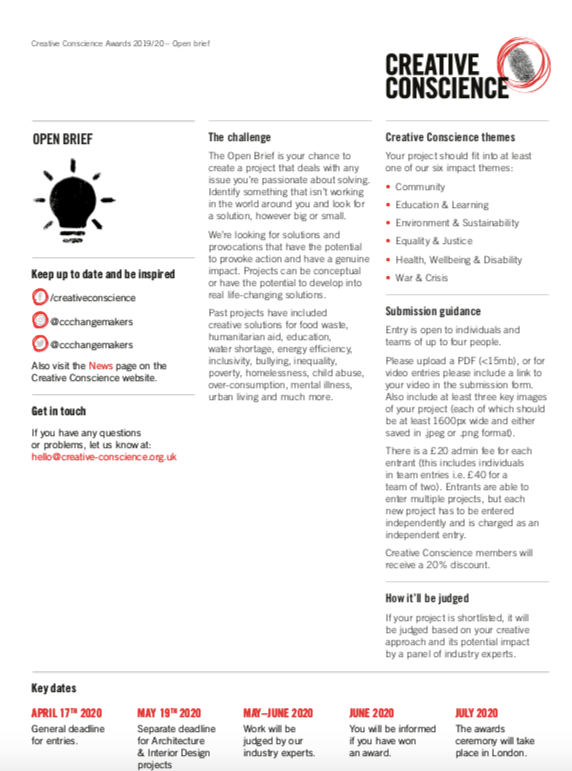
CC BRIEF / LEARNING OUTCOMES AND PICKING APART THE BRIEF:
The challenge:
The open brief is our chance to a create a project that-deals with any issues we are passionate about solving. Identify something that isn’t working in the world around you and look for a solution. Creative conscience are looking for solutions and provocations that have the potential to prove action and have a genuine impact. Projects can be conceptual or have the potential to develop into real life-changing solutions. e.g food banks, food waste, homelessness, education etc and much more.
Creative conscience themes:
the topic I chose must fit into these themes, community, education and learning, environment and sustainability, equality and justice, health and well-being, and finally war and crisis.
HOW IT HAS DO BE DELIVERED: FOR DEADLINE DAY AND TO CC.
Upload a PDF (bigger than 15mb). Also include at least three key images of your project (each of which should be at least 1600px wide and either saved in jpeg or Png format)
APP LEARNING OUTCOMES:
FOR A HIGH GRADE:
Marks awarded in this category will be awarded for work that is excellent in all aspects, and outstanding in some (lower range), or many (upper range). The work is of exceptional quality and will put forward complex and imaginative ideas in a clear and perceptive argument, deploying a wide range of resources and supporting material with rigour, responsiveness and confidence. The argument is perceptively constructed with precision, displaying critical awareness, and advancing and/or challenging knowledge and understanding, and it is faultlessly presented and communicated.
Marks in this category will be awarded for work that is very good in all aspects, and excellent in many. The work will demonstrate deep knowledge, a secure grasp of complex material, and is intelligently and inventively framed in a coherent, sophisticated argument. It is effectively constructed and eloquently presented. It explores a range of appropriate material beyond that offered on the module, showing an awareness of problems and questions. The presentation is largely faultless.
Works marked higher in this category will demonstrate very good qualities in all aspects, and excellence in some respects. The work will be fully informed, focused along a carefully planned line of argument that demonstrates originality as well as a competent and complex understanding, and displays some independence of analytical thought. It will engage with a comprehensive range of sources, which are effectively synthesized and utilised to put forward conclusions. It communicates clearly, and is presented with care.
Leanring outcomes:
The intended generic learning outcomes and, as appropriate, their relationship to programme learning outcomes
By the end of this module, students will have:
1.Developed skills of independent study, resource utilisation, problem-solving and decision-taking.
2. Developed skills of critical thinking, analysis and evaluation.
3. Developed their ability to learn through reflection on practice and experience.
4. Developed their ability to scan and organise data, abstract meaning from information and communicate in oral, written and visual formats.
5. Developed their ability to work with complex material, analyse problems and identify appropriate solutions.
Brief on Creative conscience:
Despite looking at the APP general brief and the overall brief provided by creative conscience ,the marks through this project are based through the brief provided for us towards the CC. Therefore picking this apart was necessary to achieve higher grades and set goals for my self and indicate what I needed to do to achieve them goals.
Like always I analyse the brief by printing it out and highlighting it at home which is what I did to understand the outcomes for this project already knowing the app brief and the CC brief.
Principal objectives:
To explore visual communication in Design for Good (social design)
To develop skills of designing to communicate complex or contentious information
To engage others in interactive design
To create an entry for a design competition
KEY WORDS ^
-VISUAL COMMUNCIATION
-DESIGN FOR GOOD (SOCIAL DESIGN)
COMMUNICATE COMPLEX OR CONTENTIOUS INFORMATION
ENGAGE
INTERACTIVE DESIGN
DESIGN COMPETITION
Learning outcomes
For each project it’s important to understand the learning outcomes therefore we reach the targets and meet the brief, therefore every project I write down in my blogs the learning outcomes .
The intended subject specific learning outcomes:
Demonstrate an understanding of the needs and requirements of professional practice specialism
Demonstrate the ability to articulate in various modes of implications pot critical theories for design practices and visual culture in general.
Demonstrate skills of effective visual communication through the medium of graphic design specialism.
Demonstrate critical research and analyst skills relearnt to contempt practice
The intended generic learning outcomes.
Demonstrate skills of indent study, resource utilisation, problem-solving and decision-taking.
Demonstrate their ability to leaner through reflection on practice and experience
Demonstrate their ability to scan and organise Dara, abstract meaning from information and communication knowledge in a variety of formats
work with complex material, analyse problems,ms and identify appropriate solutions