After we did our research individually we came back together as a group to undertake the outcomes we wanted to achieve and the topic we wanted to focus on. All the topics we individually investigated almost led to the focal point of patient wait time, which linked to visiting the hospital and this was where we wanted to aim towards.
OUR IDEA: PROPOSAL
We are creating a ‘card pairing flow chart’ where the audience creates their ideal hospital plan where they move the rooms to what they consider the layout should be like, and how much time each patient would roughly need to be attended and spend in that department. We are laying a floor plan made puzzle-like so the audience can rearrange it the way they see fit. Some rooms can be blank and filled with waiting area or they can be extended accordingly. But every choice has a set back and consequence. We will have tag with the name of each department and a few extras with the time set to choose how long they will spend there. Each tag will be colour coded with the importance of the department, to help guide the patient to make the correct decision. ————————————— NOTES: We could have all of the room colour coded and tell them they can only choose a certain amount in that certain category, so they can decide which one is the most important.
What we need: – All of the most important departments – Hospital floor plan (empty), like a puzzle.- An introduction paragraph.- Small Feedback sheet.- Important facts or FYIs.- Decision on materials.- Schedule- List of set backs and consequences.- Choose roles of each person.
Critical thinking – Critical thinking is the analysis of facts to form a judgment. The subject is complex, and several different definitions exist, which generally include the rational, skeptical, unbiased analysis, or evaluation of factual evidence
divergent thinking – Divergent thinking is a thought process or method used to generate creative ideas by exploring many possible solutions. It typically occurs in a spontaneous, free-flowing, “non-linear” manner, such that many ideas are generated in an emergent cognitive fashion.
convergent thinking – Convergent thinking is a term coined by Joy Paul Guilford as the opposite of divergent thinking. It generally means the ability to give the “correct” answer to standard questions that do not require significant creativity, for instance in most tasks in school and on standardized multiple-choice tests for intelligence.
Whenever we do project X we always consider different ways of thinking within the process to understand different ways of designing for good. There fore within this entire project I we had to use alternative ways of thinking such as critical thinking, divergent thinking and convergent thinking.
On Moodle there was a bunch of different tasks to undertake through this process through this blog I will focus on these activities. We had to look at each of these for us as a group to almost collect the ideas we wanted to achieve for the final outcomes and the topic. We kind of already had an idea in our head for the topics we was going to use however I did look into some of these links (not all due to time) I picked some of these that I personally felt were important and wrote notes on them, I did not think of writing notes for all however I did actually look into each specific one.
“NHS Citizen is a national programme to give the public a say on healthcare matters and influence NHS England decision-making. […] NHS England has commissioned four organisations to manage the NHS Citizen design process: The Tavistock Institute, Involve, The Democratic Society and Public-i. […] All four organisations are responsible for the delivery, engagement and operation of this website and the other project resources we’re developing, but are directly funded by – and answerable to – NHS England.”
It was initiated by government, designers & developers, non-governmental organisation/charity and researchers and encourages people to participate through an online platform, a public assembly and special events. NHS Citizen is national in orientation and concerned with health, democracy, politics and representation and participation.
It was launched in 2013 and is ongoing.
Notes from this ^ I think who is making this article is the NHS citizen, and all four of the organisation involved and funded by the NHS. Their agenda is to make awareness and to undertake of the NHS citizen and how its a national in orientation and deals with issues like health, democracy, [politics and representations and participation, educating and informing people about this.
The next one I wanted to look into from the document was caring in hospitals. When clicking on the link it directed me to a online course however I thought I could take notes from this . I feel as if the agenda for this is to make people care more in hospital and educate people. The NHS do not have a lot of staff and providing online courses and potentially enable people to want to part of the NHS whatever shape or form. It educates people what its like to be in a hospital and the aspects the staff have to take and you would have to take if you wanted to join/
Who has to pay for the NHS and when?
The final one I looked into (that I took notes on) was one about paying. I chose this because Tom in our group mentioned about immigrants having the pay for certain treatments because they are not a citizen and he had experience that therefore I wanted to understand it. Some things should not be paid for by the NHS that’s something I agree on however the argument here is where do you draw the line .
It will soon cost migrants from outside the EU £400 a year to access the National Health Service in Britain, after the government announced plans to double the fee from £200.
The NHS has long been a bastion of universal healthcare in Britain. It was established in 1948 with the ambition of providing healthcare, free at the point of service, for “everyone – rich, or poor, man, woman or child” to “relieve your money worries in times of illness”. In recent years, however, charges, increasing restrictions and complex guidance makes it difficult to know who has to pay for the NHS and when.
Historically, eligibility for free care was based on a person being “ordinarily resident in the UK”. This meant that if you moved to the UK to live and work, or you came to study, you would be entitled to free NHS care. A series of amendments to NHS regulations, starting in the 2000s, excluded a number of vulnerable groups from being eligible for free healthcare, including failed asylum seekers, undocumented migrants and those who had overstayed their visa.
I think the agenda through this article is to make aware to people what the nHS is for and the main purpose of it making it aware to the public of what to pay for and what not to pay for and the issues faced within immigrants etc.
I also watched the videos and undertook notes here.
When we returned after christmas we were put into groups. I was with Sam, Tom and Jacob. When we got put in the groups we decided as a collective to understand exactly what sub topic we was going to achieve.
We created a mind map at first on large pieces of paper that allowed us to collect all our ideas together. Tom suggested immigration , I suggested medication prescriptions and sam suggested patent wait time and all this we added on the paper to conclude what we was going to do. On the large pieces of paper we added the different aspects that each of us was going into and develop research further.
My task was looking into medication prescriptions and I also looked more in patient wait time. as I think those linked and would be used well against each other. we all went off to research then we would come back together to develop ideas further.
My research development
Medication waiting time research
During the Christmas period, I research briefly into this topic as well as patient time. I wanted to develop it further and understand it deeply for the project that we was undertaking.
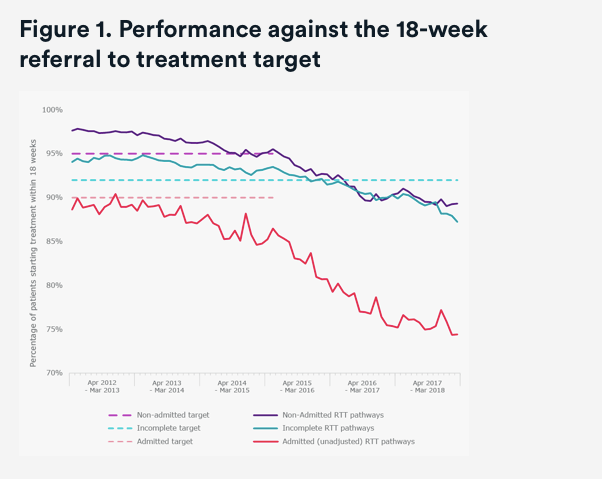
It has been said that ‘The NHS Constitution sets out that patients should wait no longer than 18 weeks from GP referral to treatment.’ which is not always the case due to the issues facing the NHS today.
The growing problem of treatment waiting time…
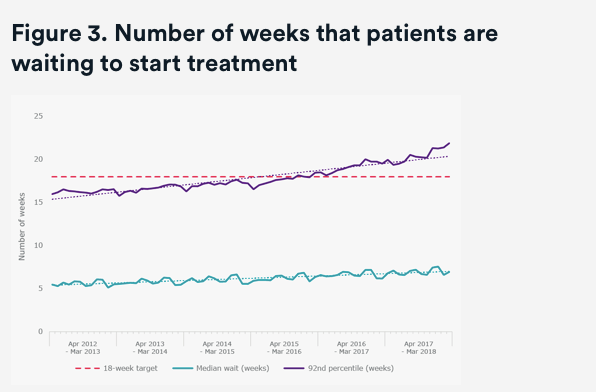
The NHS Constitution sets out that patients have a legal right to “start consultant-led non-emergency treatment within a maximum of 18 weeks of a GP referral”. The operational standard is that the time waited must be 18 weeks or less for at least 92% of patients who are waiting to start treatment (referred to as ‘incomplete pathways’). Performance against this target has worsened over the last couple of years, and the target was last met in February 2016.
In March 2018, only 87% of patients had a treatment waiting time of less than 18 weeks.
There is a reason that waiting times are longer and on this certain website they describe that. I decided to screenshot the diagrams they displayed to make it understanable towards my research.
I do not shout this out to people as its a personal aspect that I do not feel the need to share but due to this topic I wanted to write about it in blog only so please do not share. I have been on anti depressants since I was 17 due to mental health issues. the process I have experienced is disgusting in comparison to other peoples issues. I am meant to have a 6 week consultation every single 6 weeks, I have currently not had one since September due to my doctors not having a spare appointments to see me. I am able to re order my tablets on an app, which I personally feel for anti depressants this should not be a thing. I struggle frequently with my mental health and would never share it with anyone as its my own issue but I personally feel like wait time and prescriptions should be a major priority when focusing on mental health issues.
Patient wait times:
I did look into patient times during the holidays however this was something I wanted to develop further as as a group we already sort of new this was the aspects we were looking into. I looked in personal about a and e waiting times and the overall wait time for the NHS service.
The waiting time target for patients in A&E is currently set to 4 hours from arrival to admission, transfer or discharge. However, not all hospitals have urgent care centres associated, which means people with minor injuries may have a longer wait until they are seen.
Essential parts of the NHS in England are experiencing the worst performance against waiting times targets since the targets were set. This includes the highest proportion of people waiting more than four hours in A&E departments since 2004, and the highest proportion of people waiting over 18 weeks for non-urgent (but essential) hospital treatment since 2008.
The target for treating cancer patients within 62 days of urgent GP referral has not been met for over 5 years, and survey evidence suggests more people are experiencing lengthening delays in getting GP appointments.
Longer waits are a symptom of more people needing treatment than the NHS has the capacity to deliver. This reflects a decade of much lower than average funding growth for the NHS and workforce shortages, coupled with growing and changing population health needs. These pressures are exacerbated by cuts to social care and public health budgets, which make it harder to keep people healthy outside hospitals.
It will take sustained investment in the NHS and social care to reverse lengthening waits. This will include filling existing staff vacancies and growing the workforce, investment in buildings and equipment, and stabilising the social care sector.
If the NHS is to achieve its long-term vision of a service that can prevent ill-health, better manage long-term conditions, and treat people earlier, NHS staff will need time, space and skills to make change at all levels of the health and care system.
Over the Christmas period the focus for me was my dissertation however when I wanted to step away from this I felt it would be a good idea to research general facts and figures to take into consideration so when we go back in the new year I could provide this to my group. I wanted to research just general facts and figures to understand the overall impact the NHS has one people. I first looked into general facts and I then looked into more of the negative side of the NHS and the issues they face today.
NHS GENERAL FACTS:
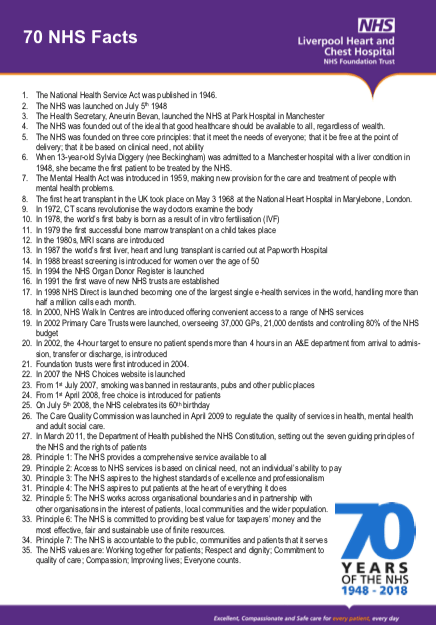
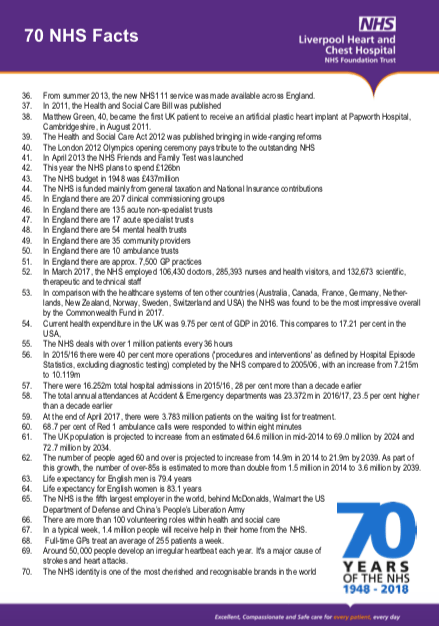
NHS Facts: The NHS is the largest employer in the UK and 5th largest in the world. NHS England is the UK’s biggest employer, closely followed by NHSScotland. The NHS employs a total of approximately 1.5 million people across England, Wales, Scotland and Northern Ireland.
I actually found a PDF that provided so much information about the NHS therefore added it here. Within this PDF it states the history of the NHS, and a variety of facts about the general information surrounding the NHS.
The reason I thought of looking into the negative side is because of experiences I have encountered. I have regular tablets where I have to have them for my well-being. I can never get an appointment for a check up and always have to get new tablets through the app as there are never appointments. My next appointment isn’t until February, whereas I have needed one since September. This led me onto the idea of patient waiting times and the issues surrounding that, which could potentially be an outcome for the group when we go back at Christmas. I then did a bunch of research based on patient waiting times.
The maximum waiting time for non-urgent, consultant-led treatments is 18 weeks from the day your appointment is booked through the NHS e-Referral Service, or when the hospital or service receives your referral letter. However, your right to an 18-week waiting time does not apply if: you choose to wait longer.
Maximum waiting times for non-urgent referrals
The maximum waiting time for non-urgent, consultant-led treatments is 18 weeks from the day your appointment is booked through the NHS e-Referral Service, or when the hospital or service receives your referral letter.
However, your right to an 18-week waiting time does not apply if:
you choose to wait longer
delaying the start of your treatment is in your best clinical interests, for example, when stopping smoking or losing weight first is likely to improve the outcome of your treatment
it is clinically appropriate for your condition to be actively monitored in secondary care without clinical intervention or diagnostic procedures at that stage
you fail to attend appointments that you had chosen from a set of reasonable options
the treatment is no longer necessary
Maximum waiting times for urgent cancer referrals
The maximum waiting time for suspected cancer is 2 weeks from the day your appointment is booked through the NHS e-Referral Service, or when the hospital or service receives your referral letter.
Note: Referrals for investigations of breast symptoms, where cancer is not initially suspected, are not urgent referrals for suspected cancer and therefore fall outside the scope of this right.
You have the legal right to ask to be seen or treated by a different provider if you’re likely to wait longer than the maximum waiting time specified for your treatment.
The hospital or clinical commissioning group (CCG) will have to investigate and offer you a range of suitable alternative hospitals or clinics that would be able to see you sooner. If you’re not happy with the organisation’s response, you can complain by following the NHS complaints procedure.
Compare waiting times
Waiting times may vary between hospitals, and you should consider this when choosing a hospital.
When you’re referred for your first outpatient appointment, the NHS e-Referral Service lets you book the appointment at a hospital or clinic of your choice, on a date and at a time that suits you.
To compare waiting times for hospitals, use the Find hospitals page. Enter the surgical procedure in the procedure box, then the postcode or your preferred location in the location box.
Note: Waiting times shown are for the specialty or service that the procedure sits under as a whole. For example, if you search for hip replacement, you will find the waiting time for Trauma and Orthopaedic patients at that hospital.
The length of time you wait will depend on your specific treatment and clinical needs, and you could be seen quicker or wait longer than the waiting time shown.
If you’re referred for a physical or mental health condition, you have the legal right to start non-urgent consultant-led treatment, or be seen by a specialist for suspected cancer, within maximum waiting times.
This right only applies to services commissioned by the NHS in England and does not include public health services commissioned by local authorities, maternity services, or non-consultant-led mental health services.
Your waiting time starts from when the hospital or service receives your referral letter, or when you book your first appointment through the NHS e-Referral Service.
During this time period, you may:
have tests, scans or other procedures to help ensure that your treatment is appropriate for your condition
have medicine or therapy to manage your symptoms until you start treatment
be referred to another consultant or department
Your waiting time ends if a clinician decides no treatment is necessary, if you decide you do not want to be treated, or when your treatment begins.
This could include:
being admitted to hospital for an operation or treatment
starting treatment that does not require you to stay in hospital, such as taking medicine
beginning fitting for a medical device, such as leg braces
agreeing to have your condition monitored for a time to see whether you need further treatment
receiving advice from hospital staff about how to manage your condition
Tip: Did you know that in most cases you have the legal right to choose the hospital or service you’d like to go to, as well as the clinical team led by a consultant or named healthcare professional?
The maximum waiting time for non-urgent, consultant-led treatments is 18 weeks from the day your appointment is booked through the NHS e-Referral Service, or when the hospital or service receives your referral letter.
However, your right to an 18-week waiting time does not apply if:
you choose to wait longer
delaying the start of your treatment is in your best clinical interests, for example, when stopping smoking or losing weight first is likely to improve the outcome of your treatment
it is clinically appropriate for your condition to be actively monitored in secondary care without clinical intervention or diagnostic procedures at that stage
you fail to attend appointments that you had chosen from a set of reasonable options
The start of the year means the start of project X. This was the first lesson (which was actually before Christmas) where we decided as a class collectively what overall topic we was going to focus on within the groups. We sat in groups that our tutor had put us in, and this would then enable us to undertake different sort of topics we would want to do as the new year approaches. I was with three people, and my approach was to go around and allow each of them to discuss what they thought was important in the world today. I came up with ocean plastic, the bush fires in Australia, and then someone said about abusing alcohol etc which led to someone saying about the NHS.
We then had to write the chosen two within our groups and write them on the board. we then went one by one to tick the one we was going to go towards.
After everyone voted it was time for us to allow one by one to vote for the best topic we could approach. The winner was NHS. From knowing that the focus would be on the NHS it allowed me to understand exactly what sort of research to undertake within the Christmas holidays. The NHS is a topic that varies over so much and contributes to so many arguments therefore for the holidays I knew I was going to just do general research throughout the NHS.




 ktwilliamsdesigns4BA